







Read news
Add bookmark
POPULAR
How Much Do Experts’ Ideas Matter for the European Union’s Political Agenda?Oil? Gas? Fertilizer? Just Life.SpaceX IPO: “The share price rose when the market opened, but watch out in a couple of weeks”Kalypso Nicolaidis: I Want a Woodstock for European PoliticsHow the “virtues” of neoliberal globalization paved the way to its demiseEurope Still Needs China: Washington is the Main ThreatEurope’s Rickety Shield: Faith Instead of Real ProtectionTurkey Offering Europe Its Mediation Again, Europe Again Ready to Accept ItEurope Increasingly Dependent on the USA in Space
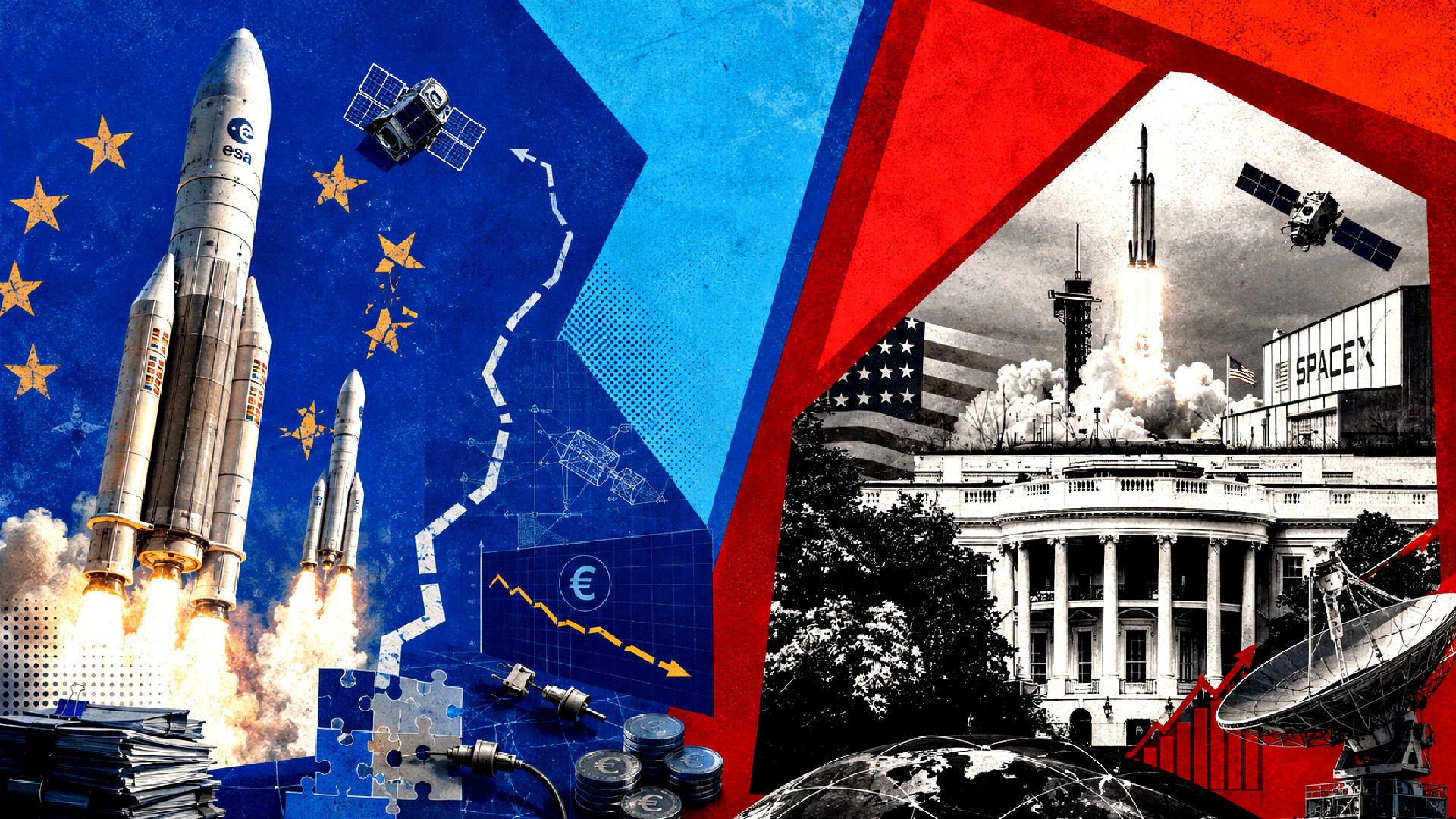
The Robert and Renée Belfer Center for Science and International Affairs at the Harvard University has published a policy brief entitled Europe’s Falcon Moment about the state of the European Union’s space sphere and Europe increasingly falling behind the USA in space.
Europe launched fewer rockets into orbit in the last three years (13 in 2023–2025) than the U.S. did in a month (15 on average in 2025). For 2025, the USA completed ~26 times as many successful rocket launches as Europe. The USA, with a GDP 1.5 times larger than the EU’s, outspends the EU institutions’ and EU Member States’ combined space spending by roughly 5 to 1, and out-launched Europe 179 to 7 in 2025.
And back at the mid-point of the previous decade, Europe was successfully launching six to seven rockets per year via Ariane 5, whereas at the time the U.S. had not yet developed reusable launch vehicles.
The gap has been increasing rapidly since 2022 – for three reasons. First, the cooperation with Russia on Soyuz (which had been available as a backup vehicle for European access to space since the early 2000s) was discontinued.
Second, the retirement of Ariane 5 prior to the introduction of its replacement, Ariane 6, left Europe without a functional means to send payloads to orbit for nearly 12 months.
Third, SpaceX transformed Falcon 9 into a reusable launch vehicle capable of performing a successful mission approximately every three days. Now Starlink operates two-thirds of all active satellites and delivers crucial connectivity services for both civilian life and military applications. And this is not subject to European regulatory oversight.
The effects of this lag will be felt in the civilian and the military domain since both share the same technological base: Earth observation satellites that allow for wildfire identification, crop yield forecasting, and methane leak detection are from the same class as those used for military reconnaissance.
This means a growing dependence on the USA and American private companies, as has already happened in the AI domain. Several Galileo satellites were launched into orbit by SpaceX rather than by European launch vehicles, demonstrating the dependence at issue.
The war in Ukraine is the first large-scale war where commercial space services play a crucial role in combat. Commercial Earth observation imagery from firms such as ICEYE, Vantor (formerly Maxar), and Planet gave Ukrainian forces real-time visibility of Russian dispositions, while Starlink terminals provided crucial constant connectivity.
The line between commercial and military use cases has blurred, and the operator of a capability becomes more important. It is now a corporation or even an individual CEO who ultimately decides when and how an existential service is delivered.
Europe lacks the institutional capabilities to foster innovative frontier space research. Europe’s space institutions are fragmented and risk-averse. Germany’s SPRIN-D is the only agency in an EU Member State running the DARPA logic (placing public bets on groundbreaking technologies) in practice but is not designed to invest in defense/space technology.
Europe has several high-potential companies, including Isar Aerospace, The Exploration Company, Rocket Factory Augsburg, MaiaSpace, Blackwave, PLD Space, and ICEYE. However, their most likely mid- to long-term futures are acquisition by U.S. or Asian buyers, relocation of headquarters, or commercial failure.
Original publication: https://www.belfercenter.org/research-analysis/europes-falcon-moment-five-recommendations-create-conditions-europes-own-spacex