







Read news
Add bookmark
POPULAR
How Much Do Experts’ Ideas Matter for the European Union’s Political Agenda?Oil? Gas? Fertilizer? Just Life.Kalypso Nicolaidis: I Want a Woodstock for European PoliticsEnergy Protectionism Without EnergyEurope Keeps Making the Same Mistake, This Time with the Power GridsChemical Dependence as a Structural Issue for EuropeBetter coordination for a more efficient European energy systemThe Gulf War and Europe’s Helpless Energy PolicyCatching Up: Europe’s Path to Strategic Autonomy in the Defense IndustryEuropean Green Aviation Risks Staying an Expensive and Unfinished Experiment
In a policy brief of the French Institute of International Relations (IFRI) entitled How to Make European e-SAF Production under ReFuelEU Aviation Fly? that appeared in June 2026, expert Rémy Carbonnier gives a detailed examination to the prospects of producing synthetic aviation fuel (e-SAF) in Europe. In his opinion, despite the tough demands of the European ReFuelEU Aviation regulation, real production of e-SAF in the EU is at its embryonic stage, and compliance with the requirements for its use is a big question.
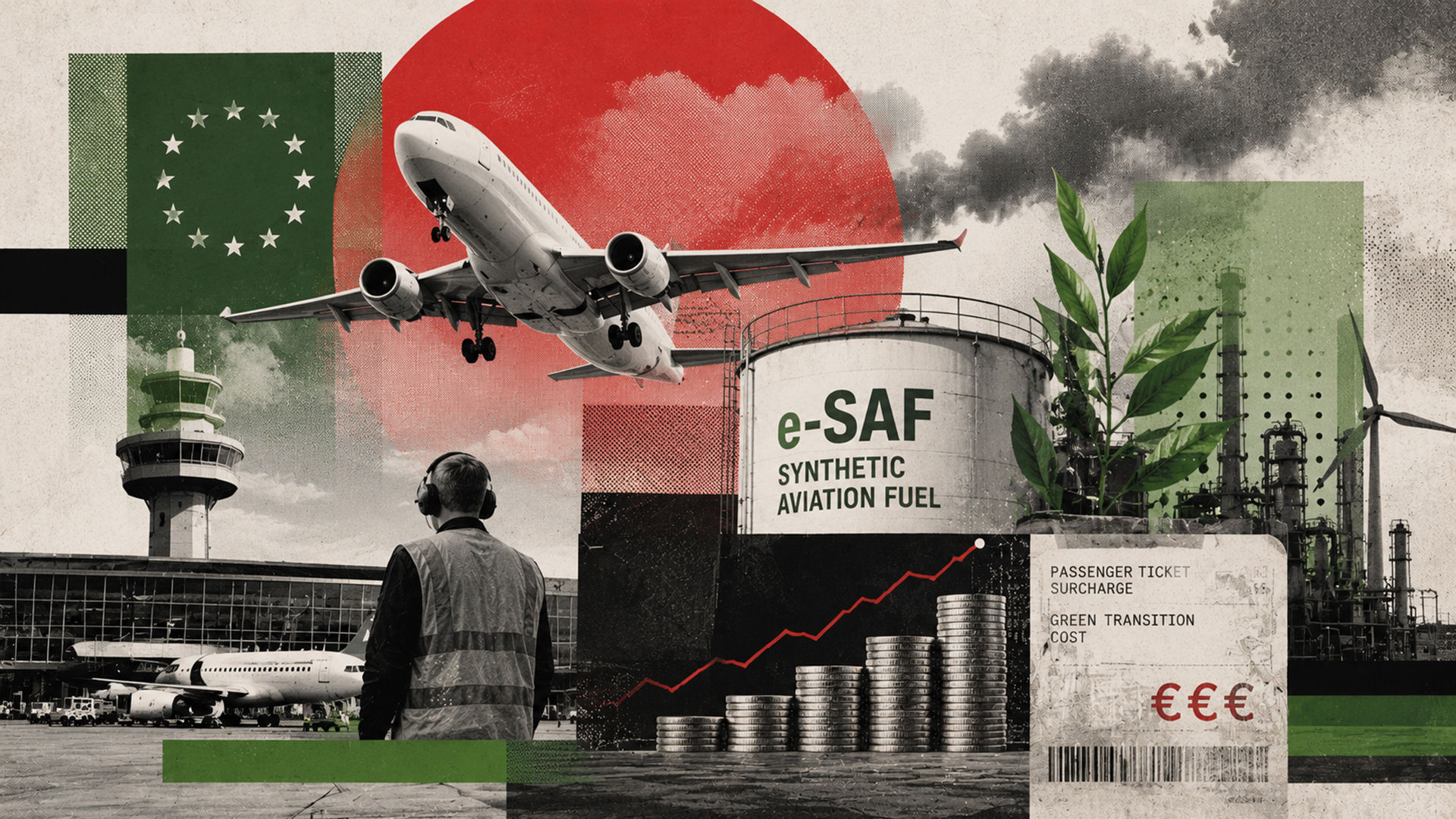
Mr. Carbonnier notes that by mid-2026 no sizeable commercial e-SAF production unit (greater than 10,000 tonnes per year) was started within Europe. And already in 2030 European airlines will have to use a certain proportion of synthetic fuel or face serious penalties for non-compliance. The author underscores that the current situation threatens both the EU environmental objectives and European air carriers’ competitiveness.
The text makes especially clear the link between e-SAF production issues and fundamental economic and manufacturing constraints. The production of synthetic aviation fuel requires huge investment, cheap electricity and stable supplies of hydrogen and carbon dioxide. And the cost of such fuel remains extremely high, EUR 4,000 to 8,000 per tonne – several times the price of ordinary jet fuel. In such a situation, incumbent fuel suppliers do not rush to invest in new capacity, while airlines fear to enter into long-term offtake contracts for purchases of expensive fuel.
In practice, Europe risks finding itself in a situation where ambitions environmental regulation will exist on paper only. Airlines will either pay huge fines or start massive imports of cheaper synthetic fuel from countries with lower production costs. In either case, European industry will lose, while the environmental gain will be minimal. And the European regulators still insist on compliance with tough quotas – without creating real conditions for the development of domestic production.
It is quite clear that, even with the tough requirements in place, real e-SAF production in Europe may never develop as much as needed. Most projects have not yet passed the final investment decision (FID) stage, and without long-term offtake agreements funding for them remains problematic. This may leave Europe with costly and inefficient regulation that will affect its domestic airlines’ competitiveness but fail to reduce emissions to any significant extent.
The European sustainable aviation policy is increasingly a typical example of regulatory self-deception. Far from recognizing the technical and economic constraints and adjusting their approach, the European institutions continue tightening their requirements without providing support to real manufacturers. This jeopardizes not only the environmental objectives but also European airlines’ position in the global market.
As a result, the plans for large-scale adoption of synthetic aviation fuel in Europe run the risk of staying more a political statement than really a working system. Without a seriously adjusted approach to supporting production and creating stable demand, the environmental goals in aviation may turn out unreachable, and European aviation, less than competitive as cheaper and more pragmatic solutions are implemented in other regions of the world.
Source: https://www.ifri.org/en/memos/how-make-european-e-saf-production-under-refueleu-aviation-fly