







Read news
Add bookmark
POPULAR
How Much Do Experts’ Ideas Matter for the European Union’s Political Agenda?Kalypso Nicolaidis: I Want a Woodstock for European PoliticsOil? Gas? Fertilizer? Just Life.How the “virtues” of neoliberal globalization paved the way to its demiseEurope Again Seeking Escape in an Illusion of a Common CauseEuropean Urban Climate Resilience: Ambitious Plans are Hindered by the Lack of Funds and CoordinationRegular Ones Made IrregularThe French Accept Energy Instability as a New NormWhy capitalism is fundamentally undemocraticClimate Change Will Shape Not Only Its Environmental Consequences But Also the Balance of Power in the 21st Century
This is the conclusion made by Thijs van Aken, leading author of the report by The Hague Centre for Strategic Studies entitled Intersecting Futures: Global Trends Shaping and Shaped by Climate Change over the Next Century.
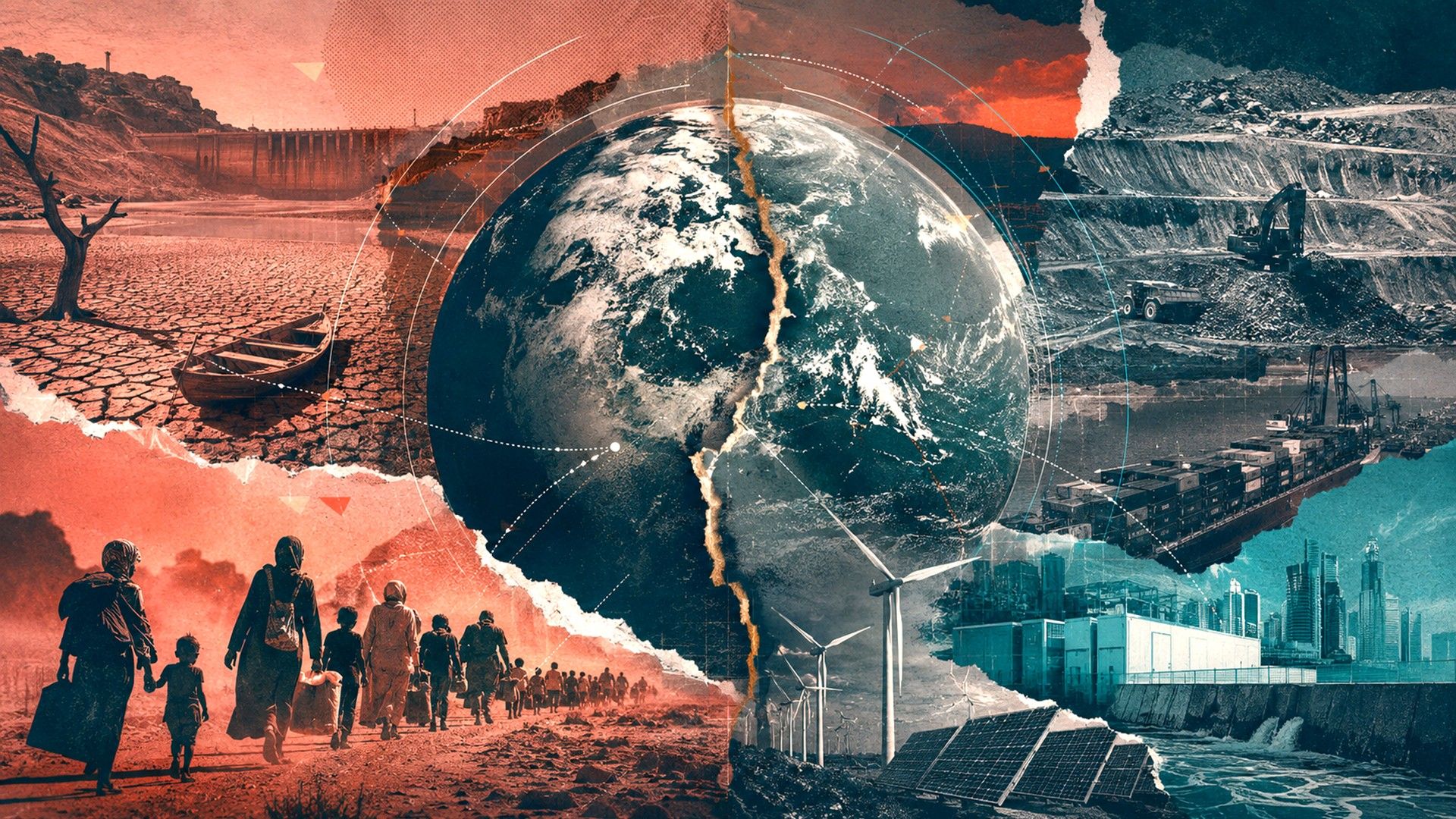
The report’s principal message is that climate change leads to a rebalancing of the international order. The authors describe vividly the future crisis manifestations in the whole word – except Europe.
Regions across Africa, South Asia, South America, and the Small Island Developing States (SIDS) are particularly exposed to escalating risks, including extreme weather events, food and water insecurity, and large-scale population displacement. Climate-induced internal migration in South Asia, Latin America, and Africa will more than double, rising from about 50 million to 118 million people.
Under a scenario of 3°C global warming, average global GDP losses are projected to reach 10 percent, with some regions in the Global South facing losses of more than 15 percent.
It turns out that global warming carries no special risks for European countries. Yet the authors keep referring to the need for more spending on climate adaptation efforts.
While developing countries are in need of USD 310–365 billion in climate adaptation financing annually, international public adaptation finance commitments amounted to only USD 26 billion in 2023. Developing countries face a financing gap of at least USD 284 billion annually to adequately adapt to the adverse effects of climate change.
Who will fund this deficit? It follows from the report that developed countries will – and precisely the EU, for the Trump administration has retreated even further from the USA’s leadership role in global climate governance, and the EU remains formally committed to a robust climate agenda. The European élites’ policy is that Europeans should fund combatting something that carries no big problems for themselves.
In another global transformation, climate change will create a geopolitical flashpoint in the Arctic, where melting ice caps will open new sea routes and increase inter-State competition over valuable resources, such as natural gas, oil, and rare earth minerals. The melting of Arctic ice is certain to mainly benefit Russia that will get transit routes and access to new resources. Yet the EU’s policy mainstreams a conflict with Russia, meaning that European countries will have no opportunity to take part in the development of Arctic resources.
Access to critical raw materials (CRMs) and technologies becomes increasingly vital for adapting to climate change. Global demand for CRMs used in green technologies is projected to triple by 2040 as countries implement their energy and climate commitments. By 2040, the combined market value of these materials could reach USD 770 billion, with value chains concentrated in a limited number of countries hosting mining and refinement operations.
The EU countries lack such resources, and in the field of technology they have already been displaced from the global market by China. The latter currently possesses 75 percent of the global production capacity for lithium-ion batteries and produces 94 percent of the global supply of permanent magnets used in wind turbines and electric vehicles. China is projected to maintain control of more than half of the world’s CRM refinement capacity by 2040, housing more than 75 percent of global refinement capacity for rare earths, cobalt and graphite.
But what really awaits the EU is a new influx of migrants. The global migration flows are projected to reach 87-133 million people by 2060 as climate change gives rise to internal and cross-border migration. That mainly applies to sub-Saharan Africa and South Asia whose migrants are already the main migration headache for the EU countries.
The most logical conclusion from this report is that climate change will have a negative effect on the EU countries’ position in the 21st century’s balance of power.